From the Following Lewis Structure and What You Know About Vsepr Theory
ix.2: The VSEPR Model
- Page ID
- 21752
Learning Objectives
- To utilise the VSEPR model to predict molecular geometries.
- To predict whether a molecule has a dipole moment.
The Lewis electron-pair approach can be used to predict the number and types of bonds between the atoms in a substance, and it indicates which atoms have alone pairs of electrons. This arroyo gives no data nearly the bodily organisation of atoms in space, still. We continue our discussion of structure and bonding past introducing the valence-beat out electron-pair repulsion (VSEPR) model (pronounced "vesper"), which can exist used to predict the shapes of many molecules and polyatomic ions. Keep in heed, however, that the VSEPR model, similar whatever model, is a express representation of reality; the model provides no data about bond lengths or the presence of multiple bonds.
The VSEPR Model
The VSEPR model tin can predict the construction of about any molecule or polyatomic ion in which the central atom is a nonmetal, too as the structures of many molecules and polyatomic ions with a fundamental metallic cantlet. The premise of the VSEPR theory is that electron pairs located in bonds and lone pairs repel each other and will therefore adopt the geometry that places electron pairs equally far apart from each other as possible. This theory is very simplistic and does not account for the subtleties of orbital interactions that influence molecular shapes; all the same, the uncomplicated VSEPR counting procedure accurately predicts the 3-dimensional structures of a large number of compounds, which cannot be predicted using the Lewis electron-pair arroyo.
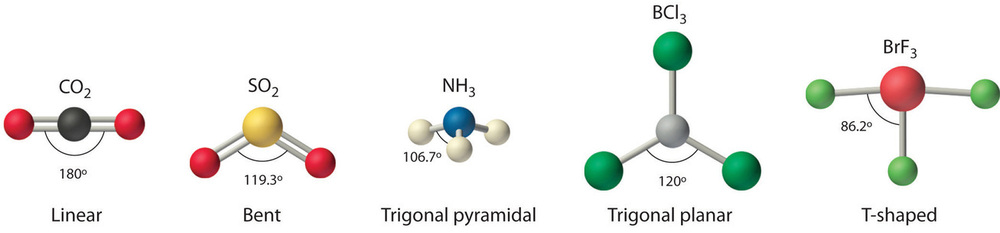
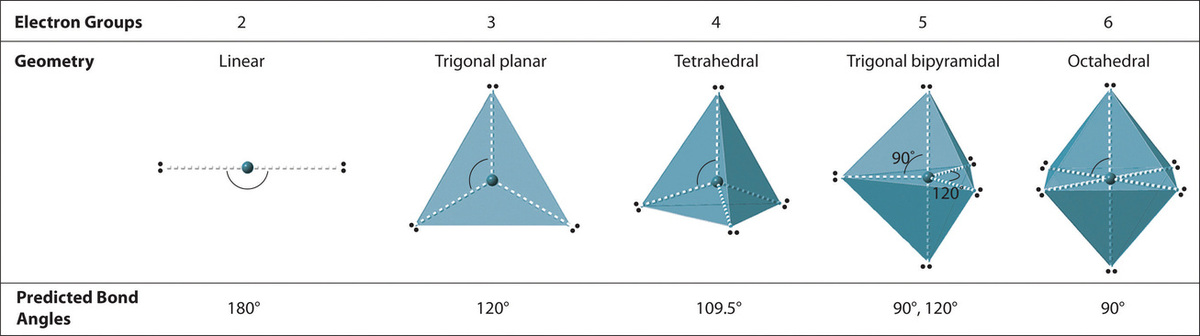
We tin utilize the VSEPR model to predict the geometry of most polyatomic molecules and ions by focusing only on the number of electron pairs effectually the central atom, ignoring all other valence electrons present. According to this model, valence electrons in the Lewis structure grade groups, which may consist of a single bond, a double bond, a triple bond, a lone pair of electrons, or even a unmarried unpaired electron, which in the VSEPR model is counted as a lone pair. Because electrons repel each other electrostatically, the well-nigh stable arrangement of electron groups (i.e., the one with the lowest free energy) is the 1 that minimizes repulsions. Groups are positioned around the key cantlet in a way that produces the molecular structure with the lowest energy, as illustrated in Figures \(\PageIndex{i}\) and \(\PageIndex{2}\).
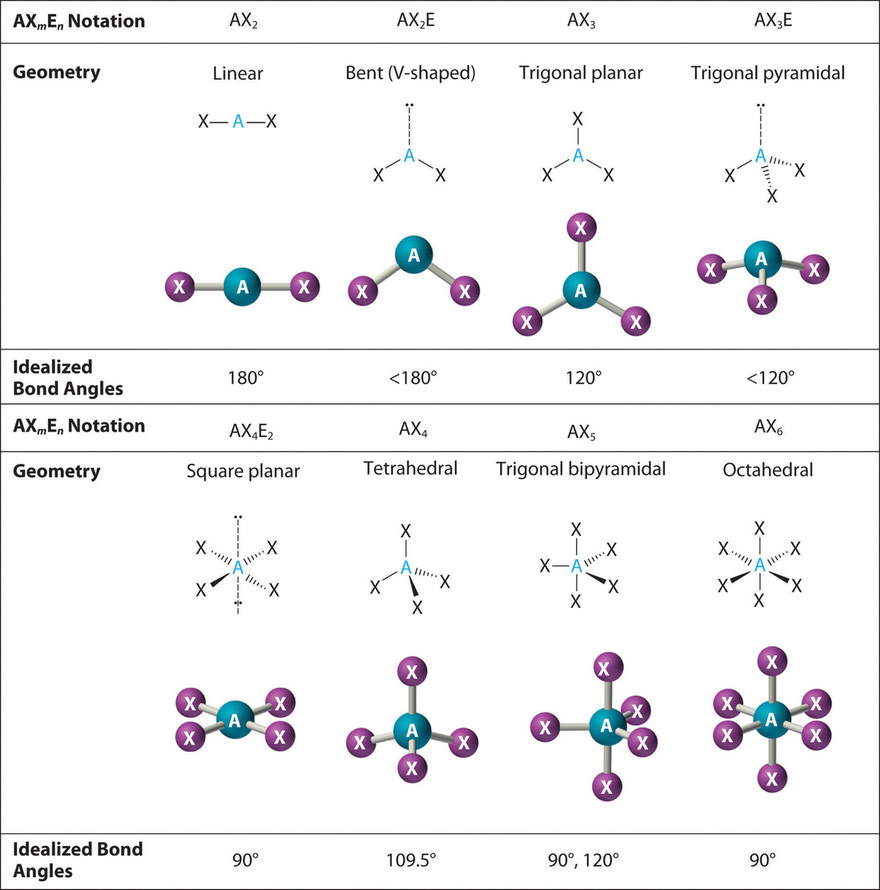
In the VSEPR model, the molecule or polyatomic ion is given an AX m Due east n designation, where A is the primal atom, Ten is a bonded atom, E is a nonbonding valence electron group (unremarkably a lonely pair of electrons), and m and due north are integers. Each grouping effectually the cardinal atom is designated every bit a bonding pair (BP) or lone (nonbonding) pair (LP). From the BP and LP interactions nosotros can predict both the relative positions of the atoms and the angles between the bonds, called the bail angles. Using this information, nosotros can draw the molecular geometry, the arrangement of the bonded atoms in a molecule or polyatomic ion.
VESPR Produce to predict Molecular geometry
This VESPR procedure is summarized every bit follows:
- Describe the Lewis electron structure of the molecule or polyatomic ion.
- Make up one's mind the electron group arrangement effectually the central atom that minimizes repulsions.
- Assign an AX m E n designation; then identify the LP–LP, LP–BP, or BP–BP interactions and predict deviations from platonic bond angles.
- Depict the molecular geometry.
We will illustrate the utilise of this procedure with several examples, beginning with atoms with two electron groups. In our give-and-take we will refer to Figure \(\PageIndex{2}\) and Figure \(\PageIndex{3}\), which summarize the mutual molecular geometries and idealized bond angles of molecules and ions with two to 6 electron groups.
Two Electron Groups
Our first example is a molecule with 2 bonded atoms and no lone pairs of electrons, \(BeH_2\).
AX2 Molecules: BeH2
ane. The central cantlet, beryllium, contributes two valence electrons, and each hydrogen atom contributes one. The Lewis electron structure is

3. Both groups effectually the central atom are bonding pairs (BP). Thus BeH2 is designated as AXtwo.
4. From Figure \(\PageIndex{3}\) we see that with two bonding pairs, the molecular geometry that minimizes repulsions in BeHii is linear.
AX2 Molecules: COtwo
1. The central cantlet, carbon, contributes four valence electrons, and each oxygen atom contributes six. The Lewis electron construction is

2. The carbon cantlet forms two double bonds. Each double bond is a group, and then there are ii electron groups around the central atom. Like BeHtwo, the organisation that minimizes repulsions places the groups 180° autonomously.
iii. In one case once again, both groups effectually the cardinal atom are bonding pairs (BP), so CO2 is designated as AX2.
4. VSEPR only recognizes groups around the primal atom. Thus the lone pairs on the oxygen atoms do not influence the molecular geometry. With ii bonding pairs on the central cantlet and no alone pairs, the molecular geometry of COtwo is linear (Figure \(\PageIndex{3}\)). The structure of \(\ce{CO2}\) is shown in Effigy \(\PageIndex{i}\).
Three Electron Groups
AXiii Molecules: BCliii
ane. The central atom, boron, contributes 3 valence electrons, and each chlorine atom contributes seven valence electrons. The Lewis electron structure is
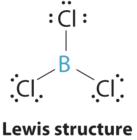
3. All electron groups are bonding pairs (BP), so the structure is designated equally AXthree.
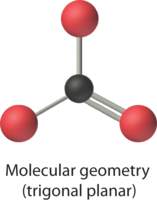
4. From Figure \(\PageIndex{3}\) we encounter that with iii bonding pairs around the fundamental cantlet, the molecular geometry of BCl3 is trigonal planar, every bit shown in Figure \(\PageIndex{2}\).
AX3 Molecules: CO3 2 −
one. The central atom, carbon, has iv valence electrons, and each oxygen atom has six valence electrons. As you learned previously, the Lewis electron structure of one of three resonance forms is represented as

3. All electron groups are bonding pairs (BP). With iii bonding groups effectually the central atom, the structure is designated as AXthree.
4. We run into from Figure \(\PageIndex{3}\) that the molecular geometry of CO3 two − is trigonal planar with bond angles of 120°.
In our next example nosotros encounter the furnishings of lonely pairs and multiple bonds on molecular geometry for the first fourth dimension.
AXtwoE Molecules: SOii
1. The central atom, sulfur, has 6 valence electrons, as does each oxygen atom. With 18 valence electrons, the Lewis electron structure is shown beneath.

3. There are two bonding pairs and one lone pair, so the construction is designated equally AXtwoE. This designation has a total of three electron pairs, two X and one E. Because a solitary pair is not shared past two nuclei, it occupies more space near the fundamental atom than a bonding pair (Figure \(\PageIndex{4}\)). Thus bonding pairs and lone pairs repel each other electrostatically in the social club BP–BP < LP–BP < LP–LP. In SO2, nosotros have one BP–BP interaction and two LP–BP interactions.
4. The molecular geometry is described merely by the positions of the nuclei, non by the positions of the lone pairs. Thus with two nuclei and one lonely pair the shape is bent, or V shaped, which tin exist viewed as a trigonal planar arrangement with a missing vertex (Figures \(\PageIndex{two}\) and \(\PageIndex{iii}\)). The O-South-O bail angle is expected to exist less than 120° because of the actress space taken up by the alone pair.

As with Sotwo, this composite model of electron distribution and negative electrostatic potential in ammonia shows that a lone pair of electrons occupies a larger region of space around the nitrogen atom than does a bonding pair of electrons that is shared with a hydrogen atom.
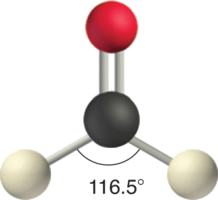
Like alone pairs of electrons, multiple bonds occupy more infinite around the fundamental cantlet than a single bond, which tin cause other bond angles to exist somewhat smaller than expected. This is because a multiple bond has a higher electron density than a single bond, so its electrons occupy more space than those of a single bond. For instance, in a molecule such as CHiiO (AX3), whose structure is shown below, the double bail repels the unmarried bonds more strongly than the unmarried bonds repel each other. This causes a deviation from ideal geometry (an H–C–H bond bending of 116.5° rather than 120°).
Four Electron Groups
One of the limitations of Lewis structures is that they depict molecules and ions in merely two dimensions. With four electron groups, we must larn to bear witness molecules and ions in three dimensions.
AX4 Molecules: CH4
i. The central atom, carbon, contributes four valence electrons, and each hydrogen atom has one valence electron, so the full Lewis electron structure is
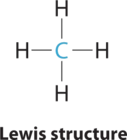
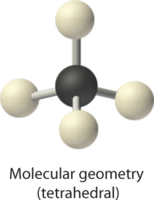
2. There are 4 electron groups around the central cantlet. As shown in Figure \(\PageIndex{2}\), repulsions are minimized by placing the groups in the corners of a tetrahedron with bond angles of 109.5°.
three. All electron groups are bonding pairs, so the structure is designated every bit AXiv.
4. With 4 bonding pairs, the molecular geometry of methane is tetrahedral (Figure \(\PageIndex{3}\)).
AX3Due east Molecules: NHthree
i. In ammonia, the primal atom, nitrogen, has 5 valence electrons and each hydrogen donates one valence electron, producing the Lewis electron structure
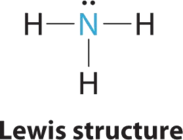
2. There are 4 electron groups effectually nitrogen, three bonding pairs and 1 lone pair. Repulsions are minimized by directing each hydrogen atom and the lone pair to the corners of a tetrahedron.
3. With three bonding pairs and one lone pair, the structure is designated as AXthreeE. This designation has a full of iv electron pairs, 3 10 and one E. Nosotros expect the LP–BP interactions to cause the bonding pair angles to deviate significantly from the angles of a perfect tetrahedron.
4. There are iii nuclei and one lone pair, so the molecular geometry is trigonal pyramidal. In essence, this is a tetrahedron with a vertex missing (Figure \(\PageIndex{3}\)). However, the H–N–H bail angles are less than the ideal bending of 109.5° considering of LP–BP repulsions (Figure \(\PageIndex{3}\) and Effigy \(\PageIndex{4}\)).
AX2Due eastii Molecules: HtwoO
1. Oxygen has six valence electrons and each hydrogen has one valence electron, producing the Lewis electron structure

3. With two bonding pairs and two lone pairs, the structure is designated equally AXtwoEast2 with a full of four electron pairs. Due to LP–LP, LP–BP, and BP–BP interactions, we expect a significant divergence from idealized tetrahedral angles.
four. With two hydrogen atoms and 2 lone pairs of electrons, the structure has significant lone pair interactions. In that location are two nuclei about the fundamental atom, so the molecular shape is bent, or V shaped, with an H–O–H bending that is even less than the H–N–H angles in NHthree, as we would expect because of the presence of two alone pairs of electrons on the central atom rather than one. This molecular shape is essentially a tetrahedron with two missing vertices.

Five Electron Groups
In previous examples it did not affair where we placed the electron groups because all positions were equivalent. In some cases, nonetheless, the positions are not equivalent. Nosotros see this state of affairs for the first time with five electron groups.
AX5 Molecules: PCl5
i. Phosphorus has 5 valence electrons and each chlorine has seven valence electrons, then the Lewis electron structure of PCl5 is
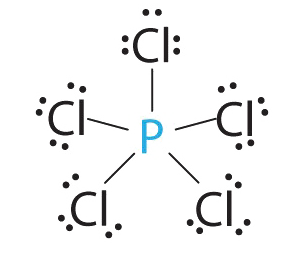
3. All electron groups are bonding pairs, so the construction is designated equally AXv. There are no lone pair interactions.
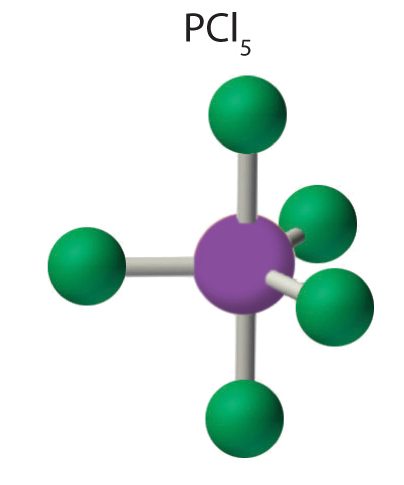
4. The molecular geometry of PClv is trigonal bipyramidal, every bit shown in Effigy \(\PageIndex{3}\). The molecule has iii atoms in a aeroplane in equatorial positions and two atoms above and beneath the plane in axial positions. The three equatorial positions are separated by 120° from one some other, and the two centric positions are at 90° to the equatorial airplane. The axial and equatorial positions are not chemically equivalent, every bit nosotros will encounter in our adjacent instance.
AX4Due east Molecules: SF4
1. The sulfur cantlet has half-dozen valence electrons and each fluorine has seven valence electrons, so the Lewis electron construction is

With an expanded valence, this species is an exception to the octet rule.
2. There are 5 groups around sulfur, four bonding pairs and ane alone pair. With v electron groups, the everyman free energy arrangement is a trigonal bipyramid, as shown in Figure \(\PageIndex{2}\).
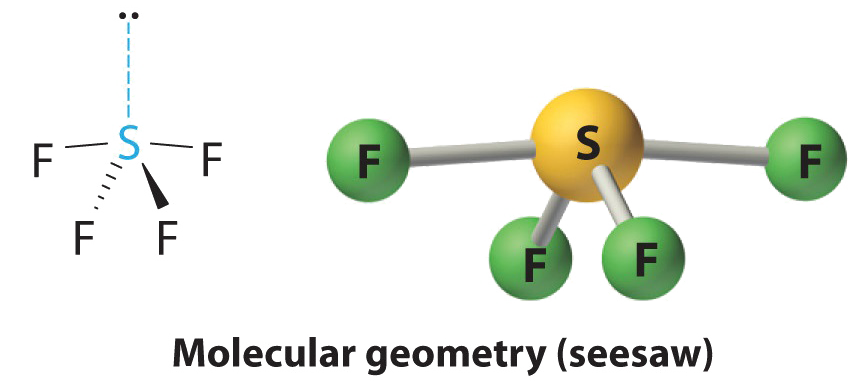
3. We designate SF4 as AXfourE; it has a total of five electron pairs. Withal, because the axial and equatorial positions are not chemically equivalent, where practice we place the lone pair? If nosotros identify the lone pair in the axial position, we have three LP–BP repulsions at xc°. If we place it in the equatorial position, nosotros have two xc° LP–BP repulsions at 90°. With fewer 90° LP–BP repulsions, nosotros can predict that the structure with the alone pair of electrons in the equatorial position is more stable than the one with the solitary pair in the axial position. Nosotros too await a deviation from ideal geometry because a lone pair of electrons occupies more space than a bonding pair.
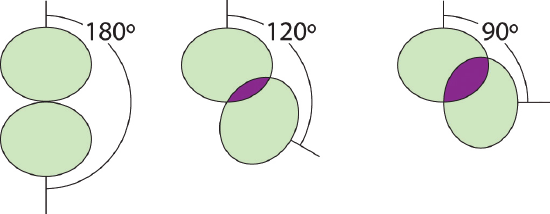
At 90°, the two electron pairs share a relatively big region of space, which leads to strong repulsive electron–electron interactions.
iv. With four nuclei and i lone pair of electrons, the molecular construction is based on a trigonal bipyramid with a missing equatorial vertex; it is described as a seesaw. The Fcentric–South–Faxial angle is 173° rather than 180° because of the lone pair of electrons in the equatorial airplane.
AX3Eii Molecules: BrFiii
ane. The bromine atom has seven valence electrons, and each fluorine has seven valence electrons, and then the Lewis electron structure is
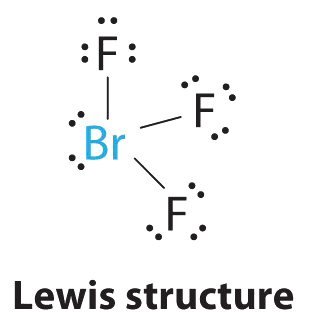
Once again, nosotros accept a compound that is an exception to the octet rule.
ii. There are v groups effectually the central atom, three bonding pairs and two lone pairs. We again direct the groups toward the vertices of a trigonal bipyramid.
iii. With three bonding pairs and two lone pairs, the structural designation is AX3E2 with a full of 5 electron pairs. Because the axial and equatorial positions are not equivalent, we must decide how to adapt the groups to minimize repulsions. If we place both lone pairs in the axial positions, we accept half-dozen LP–BP repulsions at 90°. If both are in the equatorial positions, we take four LP–BP repulsions at xc°. If one lone pair is axial and the other equatorial, we have one LP–LP repulsion at 90° and three LP–BP repulsions at 90°:
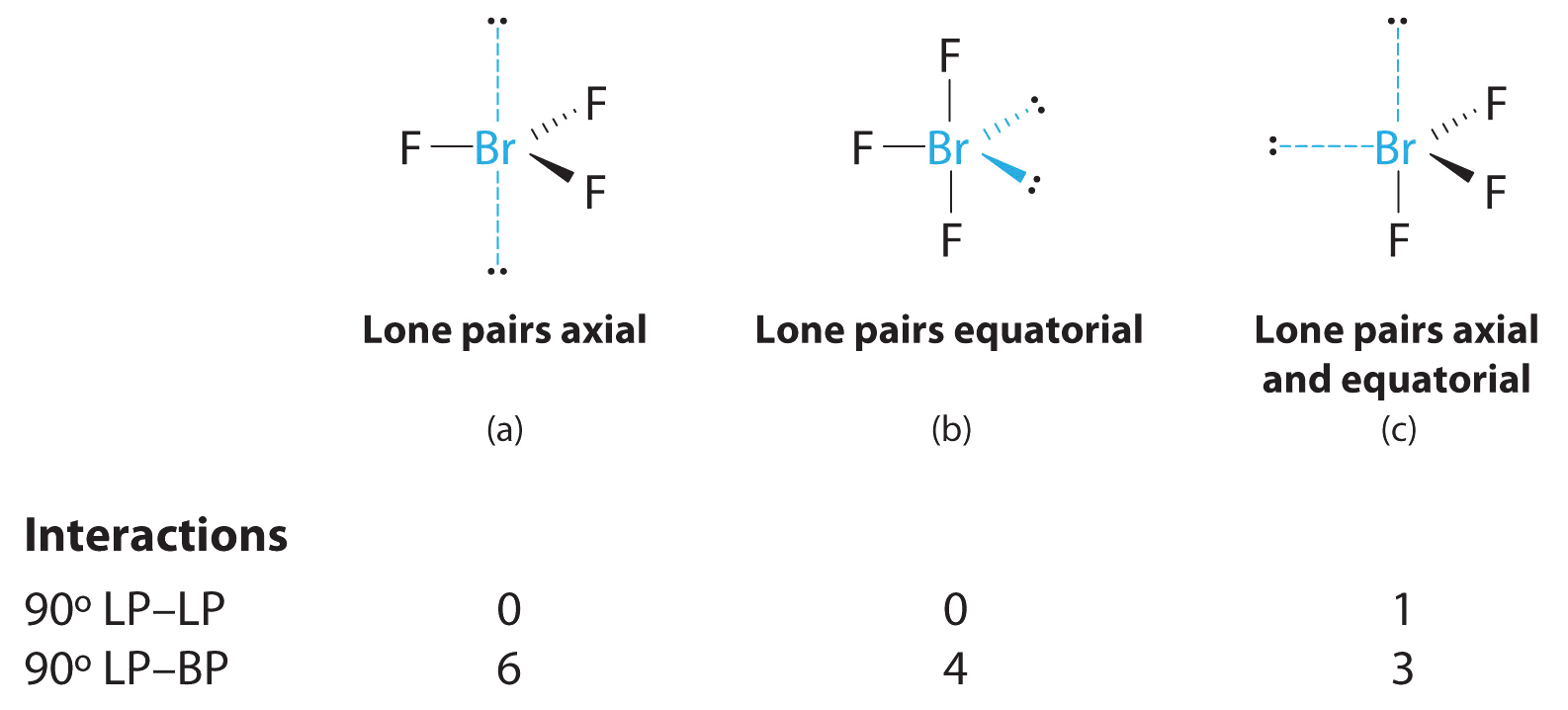
Structure (c) can be eliminated considering it has a LP–LP interaction at 90°. Construction (b), with fewer LP–BP repulsions at 90° than (a), is lower in energy. However, we predict a divergence in bond angles considering of the presence of the 2 lone pairs of electrons.
4. The three nuclei in BrF3 determine its molecular construction, which is described as T shaped. This is essentially a trigonal bipyramid that is missing two equatorial vertices. The Faxial–Br–Faxial angle is 172°, less than 180° because of LP–BP repulsions (Figure \(\PageIndex{ii}\).1).
Because lone pairs occupy more space around the central atom than bonding pairs, electrostatic repulsions are more than important for lonely pairs than for bonding pairs.
AXiiE3 Molecules: Ithree −
1. Each iodine atom contributes 7 electrons and the negative charge one, and then the Lewis electron construction is
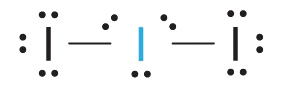
2. There are five electron groups almost the central atom in Ithree −, two bonding pairs and three lone pairs. To minimize repulsions, the groups are directed to the corners of a trigonal bipyramid.
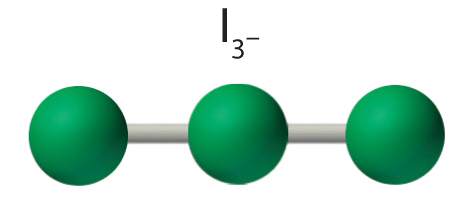
3. With two bonding pairs and iii lone pairs, I3 − has a total of five electron pairs and is designated every bit AXiiE3. We must now decide how to arrange the lone pairs of electrons in a trigonal bipyramid in a fashion that minimizes repulsions. Placing them in the centric positions eliminates xc° LP–LP repulsions and minimizes the number of 90° LP–BP repulsions.
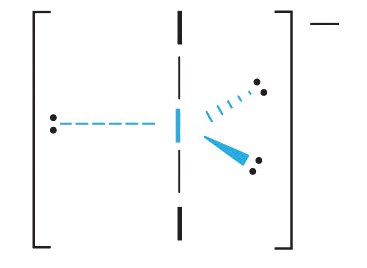
The iii lone pairs of electrons accept equivalent interactions with the iii iodine atoms, and then we do not expect any deviations in bonding angles.
four. With iii nuclei and three lone pairs of electrons, the molecular geometry of I3 − is linear. This tin be described as a trigonal bipyramid with iii equatorial vertices missing. The ion has an I–I–I bending of 180°, as expected.
Six Electron Groups
Six electron groups form an octahedron, a polyhedron made of identical equilateral triangles and six identical vertices (Figure \(\PageIndex{2}\).)
AX6 Molecules: SFvi
1. The central atom, sulfur, contributes six valence electrons, and each fluorine atom has vii valence electrons, so the Lewis electron structure is
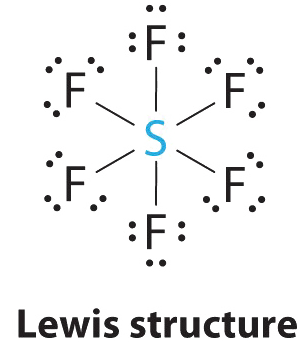
With an expanded valence, this species is an exception to the octet rule.
2. There are six electron groups effectually the primal atom, each a bonding pair. We meet from Figure \(\PageIndex{2}\) that the geometry that minimizes repulsions is octahedral.
3. With but bonding pairs, SF6 is designated as AX6. All positions are chemically equivalent, so all electronic interactions are equivalent.
4. At that place are half dozen nuclei, so the molecular geometry of SFvi is octahedral.

AX5Eastward Molecules: BrF5
ane. The cardinal cantlet, bromine, has seven valence electrons, as does each fluorine, so the Lewis electron structure is

With its expanded valence, this species is an exception to the octet dominion.
2. There are six electron groups around the Br, 5 bonding pairs and one lone pair. Placing five F atoms around Br while minimizing BP–BP and LP–BP repulsions gives the post-obit structure:
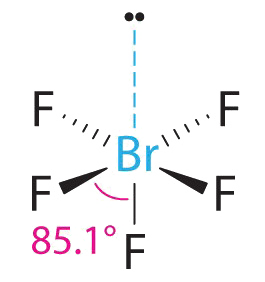
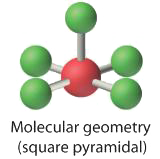
3. With five bonding pairs and one lone pair, BrF5 is designated equally AX5East; it has a full of six electron pairs. The BrFv structure has 4 fluorine atoms in a plane in an equatorial position and one fluorine atom and the solitary pair of electrons in the axial positions. We wait all Fcentric–Br–Fequatorial angles to be less than 90° because of the lonely pair of electrons, which occupies more space than the bonding electron pairs.
iv. With 5 nuclei surrounding the cardinal cantlet, the molecular structure is based on an octahedron with a vertex missing. This molecular structure is square pyramidal. The Fcentric–B–Fequatorial angles are 85.1°, less than 90° because of LP–BP repulsions.
AXivE2 Molecules: ICl4 −
i. The cardinal atom, iodine, contributes vii electrons. Each chlorine contributes vii, and in that location is a single negative accuse. The Lewis electron structure is

ii. There are six electron groups around the fundamental atom, four bonding pairs and two lone pairs. The structure that minimizes LP–LP, LP–BP, and BP–BP repulsions is
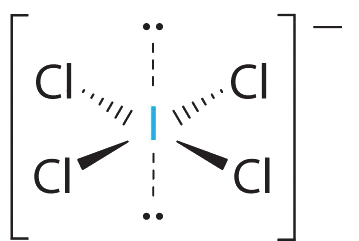
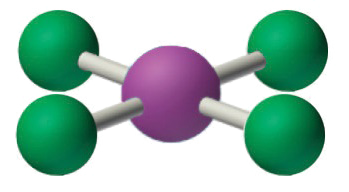
three. ICl4 − is designated every bit AXfourE2 and has a total of six electron pairs. Although there are lone pairs of electrons, with iv bonding electron pairs in the equatorial airplane and the lone pairs of electrons in the axial positions, all LP–BP repulsions are the same. Therefore, nosotros exercise not expect any deviation in the Cl–I–Cl bail angles.
4. With five nuclei, the ICl4− ion forms a molecular structure that is square planar, an octahedron with two opposite vertices missing.
The relationship between the number of electron groups effectually a central cantlet, the number of lone pairs of electrons, and the molecular geometry is summarized in Figure \(\PageIndex{six}\).
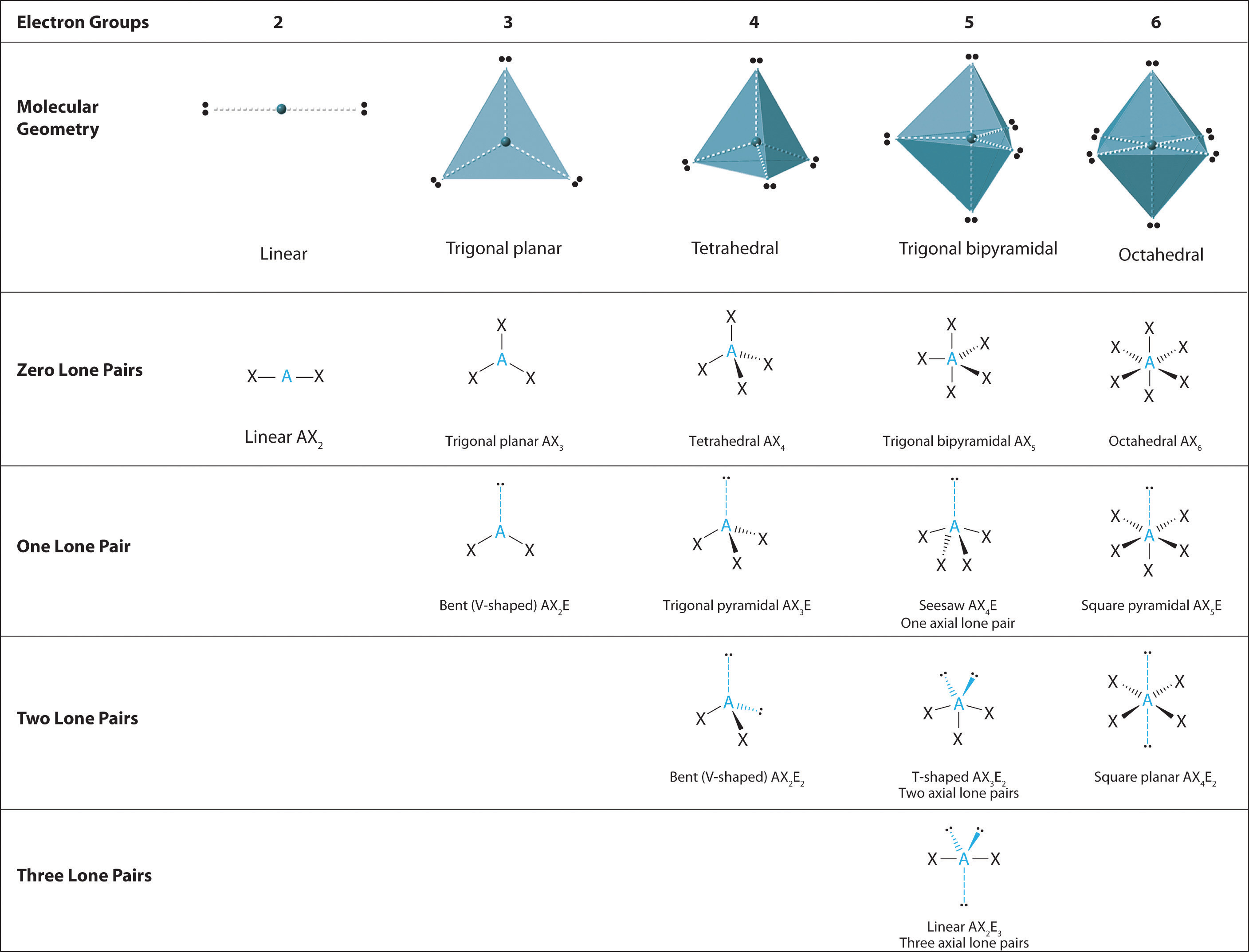
Effigy \(\PageIndex{6}\): Overview of Molecular Geometries
Example \(\PageIndex{1}\)
Using the VSEPR model, predict the molecular geometry of each molecule or ion.
- PF5 (phosphorus pentafluoride, a catalyst used in certain organic reactions)
- H3O+ (hydronium ion)
Given: 2 chemical species
Asked for: molecular geometry
Strategy:
- Draw the Lewis electron structure of the molecule or polyatomic ion.
- Make up one's mind the electron group organization around the central atom that minimizes repulsions.
- Assign an AX m E northward designation; then place the LP–LP, LP–BP, or BP–BP interactions and predict deviations in bond angles.
- Describe the molecular geometry.
Solution:
- A The central atom, P, has five valence electrons and each fluorine has 7 valence electrons, so the Lewis structure of PF5 is
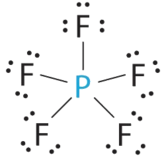
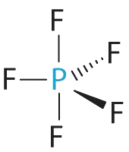
Figure \(\PageIndex{6}\)): (CC BY-NC-SA; anonymous) C All electron groups are bonding pairs, so PF5 is designated equally AXv. Find that this gives a total of five electron pairs. With no lone pair repulsions, we exercise non await any bond angles to deviate from the ideal.
D The PFfive molecule has 5 nuclei and no lonely pairs of electrons, then its molecular geometry is trigonal bipyramidal.
- A The fundamental atom, O, has six valence electrons, and each H atom contributes i valence electron. Subtracting one electron for the positive charge gives a total of viii valence electrons, so the Lewis electron structure is
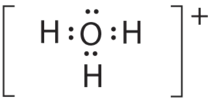
B There are four electron groups around oxygen, three bonding pairs and one lone pair. Like NH3, repulsions are minimized by directing each hydrogen atom and the lonely pair to the corners of a tetrahedron.
C With three bonding pairs and one lone pair, the structure is designated as AX3East and has a total of iv electron pairs (iii X and one E). Nosotros look the LP–BP interactions to cause the bonding pair angles to deviate significantly from the angles of a perfect tetrahedron.
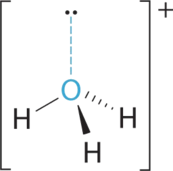
D There are three nuclei and one lonely pair, so the molecular geometry is trigonal pyramidal, in essence a tetrahedron missing a vertex. However, the H–O–H bond angles are less than the ideal angle of 109.5° because of LP–BP repulsions:
Exercise \(\PageIndex{1}\)
Using the VSEPR model, predict the molecular geometry of each molecule or ion.
- XeOthree
- PFhalf-dozen −
- NO2 +
- Reply a
-
trigonal pyramidal
- Respond b
-
octahedral
- Answer c
-
linear
Case \(\PageIndex{two}\)
Predict the molecular geometry of each molecule.
- XeFtwo
- SnCltwo
Given: two chemic compounds
Asked for: molecular geometry
Strategy:
Use the strategy given in Instance\(\PageIndex{1}\).
Solution:
- A Xenon contributes eight electrons and each fluorine seven valence electrons, so the Lewis electron structure is
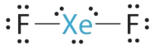
B There are five electron groups effectually the key atom, two bonding pairs and three lone pairs. Repulsions are minimized by placing the groups in the corners of a trigonal bipyramid.
C From B, XeF2 is designated as AX2Eastward3 and has a total of v electron pairs (two X and three E). With three lone pairs near the cardinal atom, we tin accommodate the 2 F atoms in three possible ways: both F atoms can be centric, ane tin can exist axial and one equatorial, or both tin exist equatorial:
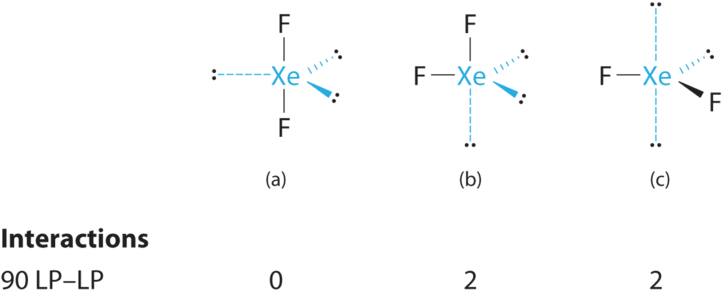
The structure with the everyman energy is the one that minimizes LP–LP repulsions. Both (b) and (c) have 2 90° LP–LP interactions, whereas structure (a) has none. Thus both F atoms are in the axial positions, like the two iodine atoms around the key iodine in I3 −. All LP–BP interactions are equivalent, so we do non await a deviation from an ideal 180° in the F–Xe–F bond angle.
D With two nuclei about the central cantlet, the molecular geometry of XeFtwo is linear. It is a trigonal bipyramid with iii missing equatorial vertices.
- A The tin atom donates iv valence electrons and each chlorine atom donates 7 valence electrons. With 18 valence electrons, the Lewis electron structure is

B In that location are three electron groups around the central cantlet, two bonding groups and ane alone pair of electrons. To minimize repulsions the three groups are initially placed at 120° angles from each other.
C From B nosotros designate SnCl2 as AX2Eastward. It has a total of iii electron pairs, 2 Ten and one E. Because the solitary pair of electrons occupies more space than the bonding pairs, we wait a decrease in the Cl–Sn–Cl bond angle due to increased LP–BP repulsions.
D With 2 nuclei around the central atom and one alone pair of electrons, the molecular geometry of SnCl2 is bent, like Then2, but with a Cl–Sn–Cl bond bending of 95°. The molecular geometry can be described equally a trigonal planar arrangement with one vertex missing.
Exercise \(\PageIndex{two}\)
Predict the molecular geometry of each molecule.
- And soiii
- XeF4
- Respond a
-
trigonal planar
- Answer b
-
square planar
Molecules with No Single Central Cantlet
The VSEPR model tin can be used to predict the construction of somewhat more than circuitous molecules with no single primal cantlet by treating them as linked AX m E n fragments. We will demonstrate with methyl isocyanate (CH3–N=C=O), a volatile and highly toxic molecule that is used to produce the pesticide Sevin. In 1984, large quantities of Sevin were accidentally released in Bhopal, India, when water leaked into storage tanks. The resulting highly exothermic reaction caused a rapid increase in pressure that ruptured the tanks, releasing large amounts of methyl isocyanate that killed approximately 3800 people and wholly or partially disabled well-nigh 50,000 others. In addition, there was significant damage to livestock and crops.
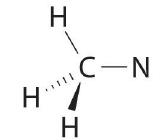
We can care for methyl isocyanate as linked AX m E n fragments showtime with the carbon atom at the left, which is connected to iii H atoms and one North atom by single bonds. The four bonds around carbon hateful that it must exist surrounded by four bonding electron pairs in a configuration similar to AX4. We tin therefore predict the CHiii–N portion of the molecule to be roughly tetrahedral, similar to methane:
The nitrogen atom is connected to one carbon by a single bond and to the other carbon by a double bail, producing a full of 3 bonds, C–Northward=C. For nitrogen to have an octet of electrons, it must also have a lone pair:
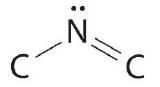
Because multiple bonds are not shown in the VSEPR model, the nitrogen is finer surrounded past three electron pairs. Thus according to the VSEPR model, the C–Due north=C fragment should be bent with an angle less than 120°.
The carbon in the –Due north=C=O fragment is doubly bonded to both nitrogen and oxygen, which in the VSEPR model gives carbon a full of two electron pairs. The N=C=O angle should therefore be 180°, or linear. The iii fragments combine to give the following construction:
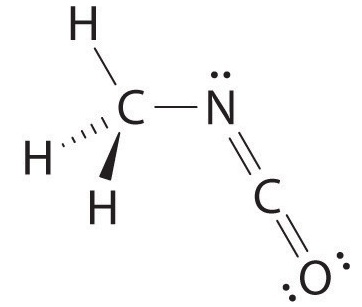
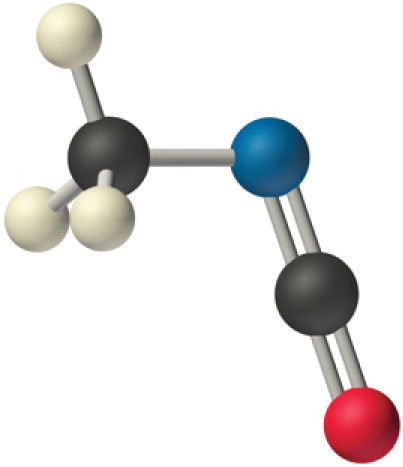
Certain patterns are seen in the structures of moderately circuitous molecules. For case, carbon atoms with four bonds (such as the carbon on the left in methyl isocyanate) are mostly tetrahedral. Similarly, the carbon atom on the right has two double bonds that are similar to those in CO2, so its geometry, like that of CO2, is linear. Recognizing similarities to simpler molecules will assistance y'all predict the molecular geometries of more complex molecules.
Example \(\PageIndex{three}\)
Use the VSEPR model to predict the molecular geometry of propyne (H3C–C≡CH), a gas with some anesthetic properties.
Given: chemical compound
Asked for: molecular geometry
Strategy:
Count the number of electron groups around each carbon, recognizing that in the VSEPR model, a multiple bond counts as a single group. Use Effigy \(\PageIndex{three}\) to determine the molecular geometry around each carbon atom so deduce the structure of the molecule as a whole.
Solution:
Because the carbon atom on the left is bonded to four other atoms, nosotros know that it is approximately tetrahedral. The adjacent 2 carbon atoms share a triple bond, and each has an additional single bond. Because a multiple bond is counted as a single bond in the VSEPR model, each carbon atom behaves every bit if it had two electron groups. This means that both of these carbons are linear, with C–C≡C and C≡C–H angles of 180°.
Practise \(\PageIndex{3}\)
Predict the geometry of allene (H2C=C=CH2), a compound with narcotic backdrop that is used to brand more complex organic molecules.
- Reply
-
The last carbon atoms are trigonal planar, the fundamental carbon is linear, and the C–C–C bending is 180°.
Molecular Dipole Moments
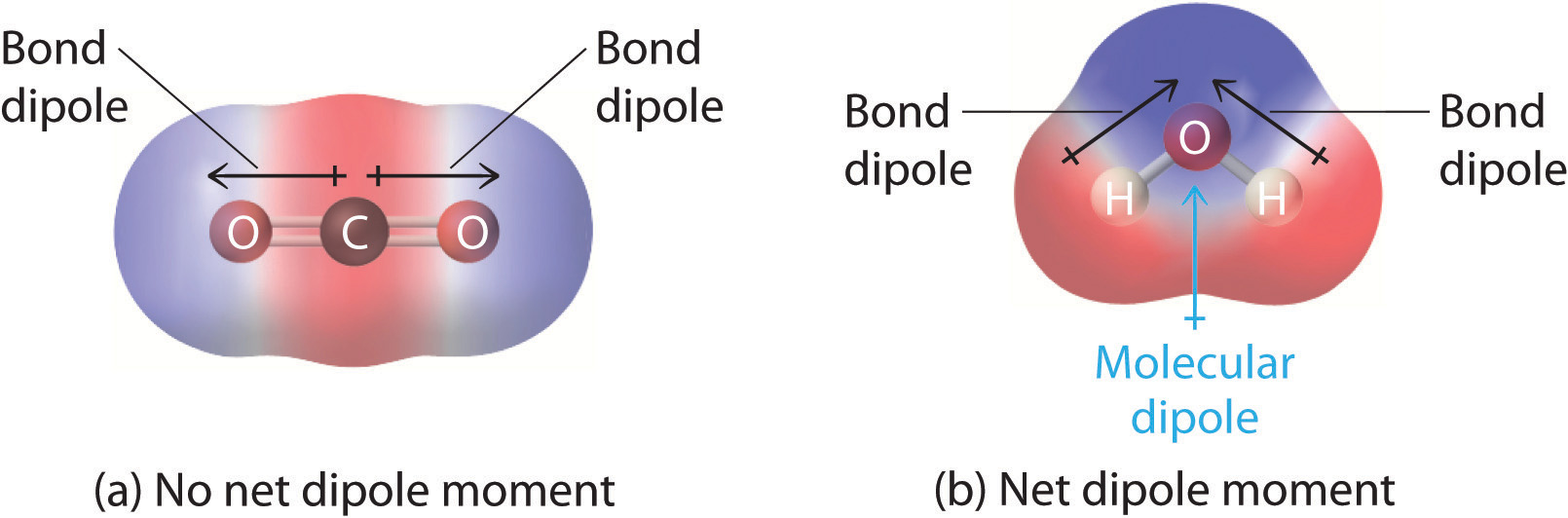
Y'all previously learned how to calculate the dipole moments of elementary diatomic molecules. In more than complex molecules with polar covalent bonds, the three-dimensional geometry and the compound's symmetry determine whether at that place is a net dipole moment. Mathematically, dipole moments are vectors; they possess both a magnitude and a direction. The dipole moment of a molecule is therefore the vector sum of the dipole moments of the individual bonds in the molecule. If the individual bond dipole moments cancel one some other, there is no net dipole moment. Such is the case for COii, a linear molecule (Figure \(\PageIndex{8a}\)). Each C–O bail in CO2 is polar, notwithstanding experiments show that the COtwo molecule has no dipole moment. Considering the two C–O bond dipoles in CO2 are equal in magnitude and oriented at 180° to each other, they abolish. As a result, the CO2 molecule has no net dipole moment even though it has a substantial separation of charge. In contrast, the H2O molecule is non linear (Figure \(\PageIndex{8b}\)); it is bent in 3-dimensional infinite, and then the dipole moments practice not abolish each other. Thus a molecule such as HiiO has a net dipole moment. We look the concentration of negative charge to exist on the oxygen, the more than electronegative atom, and positive charge on the two hydrogens. This charge polarization allows H2O to hydrogen-bond to other polarized or charged species, including other water molecules.
Other examples of molecules with polar bonds are shown in Figure \(\PageIndex{9}\). In molecular geometries that are highly symmetrical (most notably tetrahedral and square planar, trigonal bipyramidal, and octahedral), private bond dipole moments completely cancel, and there is no cyberspace dipole moment. Although a molecule like CHCl3 is all-time described as tetrahedral, the atoms bonded to carbon are not identical. Consequently, the bail dipole moments cannot cancel one another, and the molecule has a dipole moment. Due to the organisation of the bonds in molecules that have Five-shaped, trigonal pyramidal, seesaw, T-shaped, and square pyramidal geometries, the bond dipole moments cannot abolish one another. Consequently, molecules with these geometries always have a nonzero dipole moment. Molecules with asymmetrical charge distributions have a cyberspace dipole moment.

Case \(\PageIndex{4}\)
Which molecule(s) has a net dipole moment?
- \(\ce{H2S}\)
- \(\ce{NHF2}\)
- \(\ce{BF3}\)
Given: 3 chemical compounds
Asked for: net dipole moment
Strategy:
For each three-dimensional molecular geometry, predict whether the bond dipoles cancel. If they do not, then the molecule has a internet dipole moment.
Solution:
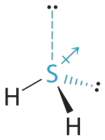
- The total number of electrons around the central cantlet, Southward, is 8, which gives four electron pairs. Two of these electron pairs are bonding pairs and ii are solitary pairs, so the molecular geometry of \(\ce{H2S}\) is aptitude (Figure \(\PageIndex{half dozen}\)). The bond dipoles cannot cancel one another, and so the molecule has a cyberspace dipole moment.
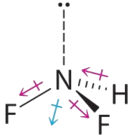
- Difluoroamine has a trigonal pyramidal molecular geometry. Because at that place is ane hydrogen and two fluorines, and considering of the lone pair of electrons on nitrogen, the molecule is not symmetrical, and the bond dipoles of NHF2 cannot abolish 1 another. This means that NHF2 has a net dipole moment. Nosotros expect polarization from the ii fluorine atoms, the most electronegative atoms in the periodic table, to have a greater touch on the net dipole moment than polarization from the alone pair of electrons on nitrogen.
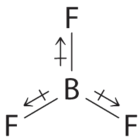
- The molecular geometry of BFiii is trigonal planar. Considering all the B–F bonds are equal and the molecule is highly symmetrical, the dipoles cancel i another in three-dimensional space. Thus BFiii has a net dipole moment of zero:
Exercise \(\PageIndex{four}\)
Which molecule(s) has a net dipole moment?
- \(\ce{CH3Cl}\)
- \(\ce{SO3}\)
- \(\ce{XeO3}\)
- Answer
-
\(\ce{CH3Cl}\) and \(\ce{XeO3}\)
Summary
Lewis electron structures give no information well-nigh molecular geometry, the arrangement of bonded atoms in a molecule or polyatomic ion, which is crucial to understanding the chemistry of a molecule. The valence-shell electron-pair repulsion (VSEPR) model allows us to predict which of the possible structures is really observed in most cases. It is based on the assumption that pairs of electrons occupy space, and the lowest-energy structure is the one that minimizes electron pair–electron pair repulsions. In the VSEPR model, the molecule or polyatomic ion is given an AX 1000 E due north designation, where A is the key atom, 10 is a bonded cantlet, E is a nonbonding valence electron grouping (usually a lone pair of electrons), and m and n are integers. Each grouping around the central atom is designated equally a bonding pair (BP) or lone (nonbonding) pair (LP). From the BP and LP interactions we tin predict both the relative positions of the atoms and the angles betwixt the bonds, called the bond angles. From this we tin can describe the molecular geometry. The VSEPR model can be used to predict the shapes of many molecules and polyatomic ions, simply information technology gives no information nearly bond lengths and the presence of multiple bonds. A combination of VSEPR and a bonding model, such as Lewis electron structures, is necessary to empathise the presence of multiple bonds.
Molecules with polar covalent bonds tin have a dipole moment, an asymmetrical distribution of accuse that results in a tendency for molecules to align themselves in an applied electric field. Any diatomic molecule with a polar covalent bail has a dipole moment, but in polyatomic molecules, the presence or absenteeism of a cyberspace dipole moment depends on the construction. For some highly symmetrical structures, the individual bond dipole moments abolish 1 some other, giving a dipole moment of zero.
Source: https://chem.libretexts.org/Bookshelves/General_Chemistry/Map%3A_Chemistry_-_The_Central_Science_(Brown_et_al.)/09._Molecular_Geometry_and_Bonding_Theories/9.2%3A_The_VSEPR_Model

Post a Comment for "From the Following Lewis Structure and What You Know About Vsepr Theory"